UK Buyer's Guide · Updated May 2026
Best Robot Lawn Mowers UK 2026
For years, robot mowers were a curiosity - something for tidy-minded enthusiasts with a flat rectangular lawn and a healthy budget. Then 2024 happened. Suddenly there were two types. The new wire-free robots you can set up in 20 minutes via an app, and the proven boundary-cable models Husqvarna and Bosch have been quietly refining for a decade. Our picks here are built from manufacturer specifications, verified owner reviews on Amazon UK and retailer sites, and UK pricing data, cross-checked to find which ones actually keep a British lawn looking like a lawn, and which ones just gather mud.
Independent · No manufacturer paid for placement · We may earn a commission on qualifying purchases.
So what is a robot lawn mower, exactly?
Picture a Roomba, but for grass. A small, low-slung battery-powered machine that lives in a charging dock by the side of the lawn and trundles out on a schedule you set. It uses lightweight razor blades on a free-spinning disc - completely different from a rotary mower's heavy fixed blade - and takes only a tiny shaving off the grass each pass. Clippings drop back onto the lawn as fine mulch. You barely see them.
The category split in two in 2024. The old guard, boundary-cable robots, follow a thin wire pegged or buried around your lawn - that's Husqvarna Automower, Bosch Indego, Stiga, Robomow. The new wave, wire-free robots, use GPS-RTK satellites, on-board cameras, or both, and let you draw virtual boundaries in an app - that's Mammotion Luba, Worx Landroid Vision, Husqvarna NERA, Segway Navimow, EcoFlow Blade. The wire-free category is genuinely only two or three years old at the consumer end, and it gets noticeably better with every firmware update.
Boundary cable or wire-free - which to buy
The single biggest decision when buying a robot mower in 2026 is whether to install a boundary cable. Here is how the choice breaks down.
| Factor | Boundary cable | Wire-free (RTK / vision) |
|---|---|---|
| Setup time | Half a day pegging or burying cable | 20-60 minutes drawing in app |
| Setup cost | £0-£40 cable | £0 (RTK aerial included) |
| Reliability | 10+ years of refinement | Improving - firmware-dependent |
| Boundary changes | Re-peg or re-bury | Edit in app in 30 seconds |
| Sky view requirement | None | RTK needs decent sky |
| Heavy tree shade | Fine | Vision-only models struggle |
| Price band | £500-£2,000 | £900-£3,500 |
Real talk: if your lawn is roughly rectangular, fairly flat, has a decent view of the sky, and you don't mind giving up one Saturday to lay cable, boundary cable still wins on both price and reliability. If your garden is awkwardly shaped, you move borders around often, or you'd rather just unbox-it-and-go - pay the wire-free premium. Worth it.
How we choose these robot mowers
We don't run a test lab and we don't pretend to. Our recommendations are built from published manufacturer specifications, verified owner reviews on Amazon UK and retailer sites, and UK pricing data, cross-checked so the numbers on this page match the numbers you'll find on the box. Where a figure is the maker's claim rather than an independent measurement, we say so.
Rankings are based on cut quality, battery and runtime for the garden size in question, weight, build, and value at UK prices. We update picks when models are discontinued or superseded. We earn affiliate commission on some links, but it never decides the order of a list. More on our method.
Best robot lawn mowers for 2026
Husqvarna Automower 305
Husqvarna
The Automower platform is the 1.0 product the entire robot mower category was built around. The 305 is the right size for the average UK back garden - 600 m² coverage, manages a 40% slope without complaint, and Husqvarna firmware is the most mature on the market by a country mile. The only real downside is the perimeter cable: budget half a day to peg or bury it.
Pros
- + 11+ years of refined Husqvarna firmware
- + Climbs slopes up to 40%
- + App control + GPS theft alarm
Cons
- − Boundary cable installation is half a Saturday
- − Replacement blades every 8-10 weeks
Mammotion Luba 2 AWD 1000
Mammotion
The wireless robot mower category finally grew up in 2024 and the Luba 2 is the best-reviewed of the new generation. RTK-GPS plus on-board cameras means you draw your boundary in the app rather than digging in 200 metres of cable. AWD makes it the only robot we trust on a properly bumpy lawn.
Pros
- + No perimeter wire - RTK-GPS + vision
- + True 4WD copes with tussocky lawns
- + App-set virtual boundaries take 20 minutes
Cons
- − Needs decent sky view for RTK
- − Heavier than wire-based rivals

Worx Landroid Vision M800
Worx
The most affordable way to get into wire-free robot mowing. Vision identifies grass vs flower bed via camera in real time - magic when it works, finicky on lawns with heavy tree shade. For a regularly mown 400-600 m² lawn in good light, the Vision M800 punches well above its price.
Pros
- + No perimeter wire (camera-led)
- + Cheapest mid-tier wire-free robot
- + Slots into the Worx 20V battery ecosystem
Cons
- − Camera struggles on heavily shaded lawns
- − Smaller battery - needs 2 charges for 800 m²

Bosch Indego S+ 500
Bosch
The neat-freak choice. Most robot mowers wander randomly; the Indego maps your garden on the first run and mows in tidy parallel lines, so the cut quality is more uniform and finishes faster. Best for flat, formal lawns under 500 m².
Pros
- + Maps the lawn and mows in straight parallel lines
- + Quiet - under 65 dB
- + Bosch SmartHome integration
Cons
- − Boundary cable required
- − Struggles on slopes over 27%
Stiga A 1500
Stiga
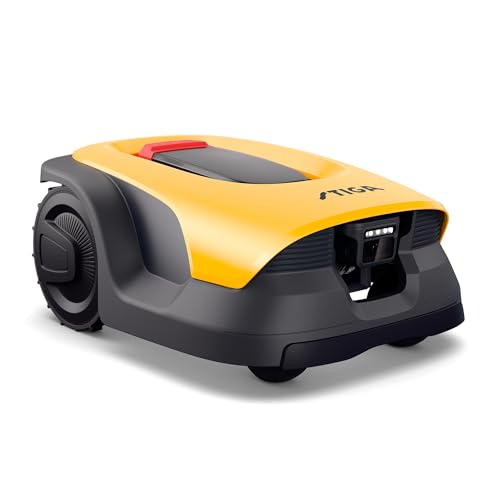
For lawns between 800 and 1,500 m², Stiga undercuts the equivalent Husqvarna and Worx machines by £200-400 and the cut quality is identical. Well worth a look for big gardens.
Pros
- + Up to 1,500 m² coverage
- + AGS Active Guidance System for efficient routing
- + Genuine UK after-sales via Stiga dealers
Cons
- − Boundary cable required
- − Italian brand - fewer YouTube tutorials
What to actually look for when buying a robot lawn mower
Match coverage to your lawn size
Robot mowers are sold by maximum coverage area, in m². Buying a robot rated for 1,500 m² when you have 400 m² is wasteful but works fine; buying a 400 m² model for a 1,000 m² lawn is asking for trouble - the battery cannot keep up, the lawn ends up under-mowed, and the motor wears out faster.
- Up to 250 m² - entry-level robots. Bosch Indego S, Husqvarna 105, Worx Landroid S
- 250-600 m² - bestselling middle tier. Husqvarna Automower 305, Bosch Indego S+ 500, Robomow RX
- 600-1,500 m² - Stiga A 1500, Husqvarna 415X, Mammotion Luba 1000
- 1,500 m²+ - Husqvarna 450X NERA, Mammotion Luba AWD 5000, dedicated commercial models
Maximum slope
The single most overlooked spec. Most domestic robots are rated 25-35%. A 35% gradient is the slope of an average UK suburban lawn corner, so 35% is fine for most. If your lawn includes a bank or a slope above 35%, you need an Automower X-Line (40%) or a 4WD robot like the Mammotion Luba 2 AWD (45%).
Cutting width and number of blades
Robot deck widths range from 17 cm (small Indegos, Worx S) up to 30 cm (large Husqvarnas and commercial Stigas). Wider decks finish faster but cost more. Three-blade discs cut more cleanly than single-blade systems and produce a finer mulch.
App, scheduling and connectivity
Look for proper smartphone scheduling (every modern robot has it), GPS theft alarm (Husqvarna and Stiga lead here), weather-based skip logic (Husqvarna and Worx do this best), and integration with Alexa or Google Home if that matters to you. Wi-Fi connectivity is now standard except on the cheapest sub-£500 models.
After-sales support
Robot mowers are computers in plastic shells - firmware updates and parts availability matter more than for any other mower category. Husqvarna, Bosch and Stiga have UK dealer networks. Mammotion, Segway and Worx are direct-to-consumer with online support. Cheaper Chinese-brand robots on Amazon often have no UK warranty path - be very cautious.
The robot mower brands worth shortlisting
- Husqvarna - invented the category, still the gold standard. Automower (cable) and NERA (wire-free) ranges.
- Bosch - Indego with logical-cut mapping, best for tidy formal lawns.
- Mammotion - leading wire-free brand. Luba 2 RTK + vision is the model to know.
- Worx - best budget option. Landroid Vision is the cheapest serious wire-free robot.
- Stiga - strong UK dealer network, good value at 1,000-1,500 m².
- Segway Navimow - newer entrant, RTK-based, improving.
- EcoFlow Blade - premium wire-free with built-in trimmer arm. Niche but interesting.